
India is now firmly on the itinerary of global business education. Executive MBA cohorts, public-policy schools, business-school electives and corporate leadership programmes increasingly want an India module. The reasons are obvious. India is large, young, digital, entrepreneurial, geopolitically relevant and economically consequential. It is also complicated, noisy, uneven and difficult to summarise.
That is precisely why India matters as a classroom.
The challenge, however, is that many immersion programmes still treat India as a destination rather than a learning system. They bring participants to a few large cities, arrange meetings with impressive companies, add a policy conversation, visit a start-up hub, include a cultural evening and leave with the conclusion that India is “dynamic”, “complex” and “full of potential”. All three statements are true. None is sufficient.
A serious India immersion must do more. It must help visiting executives understand how this country actually works: how decisions are made under constraint, how scale is built across diversity, how digital public infrastructure changes markets, how policy translates into execution, how consumers behave across income and geography, how institutions adapt, and how leaders operate when certainty is scarce.
India should not be presented as a spectacle. It should be taught as a management laboratory.
That requires design.
The first principle is that an India immersion must begin with questions, not locations. Too many programmes are built around cities because cities are easier to sell. Bengaluru means technology. Mumbai means finance. Delhi means government. Hyderabad means pharma and digital capability. Chennai means manufacturing and services. These associations are useful, but they can also become lazy shorthand.
The more important question is: what should participants learn?
If the purpose is to understand innovation at scale, then a programme must examine not only start-ups but also enterprises, public platforms, regulators and adoption behaviour. If the purpose is to understand leadership in complexity, then participants must meet leaders who manage ambiguity across markets, partners, policy and people. If the purpose is to study inclusive growth, then the itinerary must include models that serve first-generation consumers, smaller enterprises and communities beyond the metropolitan elite. If the purpose is to understand distribution, the cohort must leave the polished corporate office and study the field.
The city should follow the learning objective. Not the other way around.
The second principle is that India cannot be taught through success stories alone. Success stories are important because they reveal what is possible. But they often conceal the management struggle behind the outcome. A unicorn visit may impress. A manufacturing plant may demonstrate discipline. A bank may describe digital transformation. A large enterprise may showcase scale. Yet the real learning usually lies in the unresolved questions: what failed before this model worked, what had to be adapted, what trade-offs were accepted, what regulation enabled or constrained the outcome, and what remains fragile.
Executive learners do not need corporate theatre. They need operating truth.
This is why the best India immersions should include tension. Not controversy for its own sake, but productive tension. India’s story is not one of smooth ascent. It is a story of simultaneous progress and friction. Digital payments may be world-class, while last-mile service remains uneven. A city may house global technology capability and still struggle with infrastructure. A company may scale rapidly while facing talent, governance and execution challenges. A consumer may be digitally sophisticated in one context and deeply relationship-driven in another.
These contradictions are not distractions from the India story. They are the India story.
The third principle is to build the programme around systems, not sectors. India is too often explained sector by sector: banking, healthcare, technology, manufacturing, retail, education, logistics. This is convenient but incomplete. What makes India valuable for executive education is the way systems intersect. A fintech story is also a policy story, a trust story, a data story and a distribution story. A healthcare story may involve regulation, insurance, family decision-making, tier-2 access, talent shortages and digital adoption. A manufacturing story may involve infrastructure, state policy, supplier networks, workforce capability and global supply-chain repositioning.
The programme must therefore help participants connect the dots.
A visit to a digital payments company should be linked to conversations on public infrastructure, informal commerce and consumer trust. A corporate visit should be linked to talent markets and leadership culture. A policy briefing should be tested against execution realities on the ground. A start-up conversation should be balanced with an enterprise discussion on scale, governance and profitability. A sustainability conversation should move beyond ESG language into energy, water, waste, urbanisation and operating cost.
India rewards integrated thinking. So should an India immersion.
The fourth principle is to go beyond the obvious voices. Too many programmes expose participants only to founders, CEOs, investors, policymakers and senior academics. These voices matter. But they are not enough. To understand India, participants must also hear from the people who translate strategy into reality: regional managers, distribution partners, service leaders, public administrators, plant supervisors, social-sector operators, family-business owners, local entrepreneurs and consumers.
The frontline is not a footnote in India. It is an intelligence system.
A regional sales leader can explain demand better than a market forecast. A distributor can reveal how trust is built. A service manager can expose where product design fails. A local entrepreneur can explain capital constraints more sharply than a macroeconomic presentation. A public official can show the distance between policy intent and field execution. A customer conversation can challenge the assumptions embedded in a business-school case.
The best learning often comes from voices that are rarely on the stage.
The fifth principle is to include tier-2 India. This is no longer optional. A programme restricted to Delhi, Mumbai and Bengaluru risks teaching only the most visible layer of the country. India’s next growth story is increasingly distributed across smaller cities, regional industrial clusters, logistics corridors, education hubs, healthcare networks, digital marketplaces and family-business ecosystems.
Tier-2 India teaches lessons that metros often blur. It shows how aspiration behaves when income is uneven but ambition is rising. It shows why distribution is not merely logistics but trust. It shows why pricing must be designed around perceived value, not only affordability. It shows why service design must include human reassurance, not just digital convenience. It shows why local partners are often strategic assets, not channel intermediaries.
For global executives, these are not India-only lessons. They are lessons in emerging-market growth, institutional adaptation and the future of consumption.
The sixth principle is that immersion should not become corporate tourism. A well-designed programme is not a sequence of impressive meetings. It is a learning journey with pre-work, hypotheses, field exposure, reflection and synthesis. Participants should arrive with questions, not just curiosity. They should be asked to test assumptions, compare models and identify transferable insights.
Before arrival, they should understand the basic frame: India’s economic structure, demographic shifts, digital public infrastructure, federal system, regulatory environment, urbanisation patterns and consumption diversity. During the programme, they should encounter these themes in lived form. After each visit, they should be asked not merely what they saw, but what it means.
- What assumption did this visit challenge?
- What did this organisation adapt for India?
- What would not transfer easily to another market?
- What was enabled by policy, infrastructure or culture?
- What constraint produced innovation?
- What would break if the model scaled further?
- What should global executives learn from this?
Without reflection, immersion becomes exposure. Exposure is useful, but it is not education.
The seventh principle is to avoid the two common traps: romanticising India and simplifying India.
Romanticising India turns complexity into charm. It celebrates improvisation without asking why improvisation is necessary. It admires entrepreneurial energy without examining institutional friction. It praises resilience while ignoring the cost imposed on people and systems. This produces sentimental learning, not managerial insight.
Simplifying India creates the opposite error. It reduces the country to a market-size cliché: 1.4 billion people, a rising middle class, digital adoption, young demographics and growth potential. These are real facts, but they are not strategy. Large numbers do not automatically create accessible markets. Digital adoption does not automatically create trust. Youth does not automatically create employability. Growth does not automatically create inclusion.
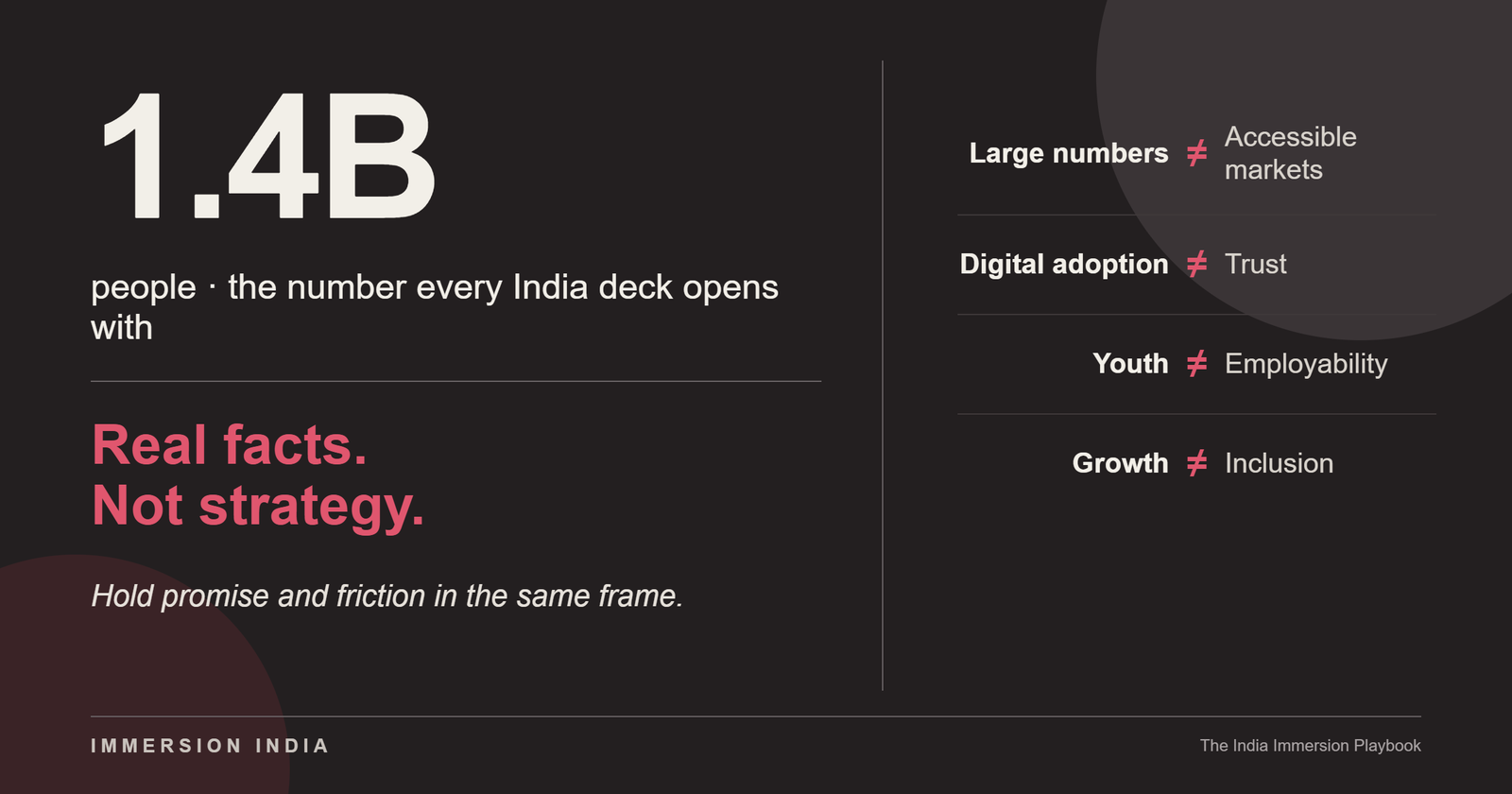
A good immersion programme must hold both promise and friction in the same frame.
The eighth principle is to treat culture as business infrastructure. Culture should not be confined to an evening performance, a heritage walk or a food experience, valuable though these may be. In India, culture affects management. It shapes negotiation, hierarchy, risk, trust, family influence, consumer aspiration, language, status, work relationships and institutional behaviour.
An executive who misunderstands these signals may misread the market.
For example, a polite “yes” in a meeting may not mean agreement. A customer’s willingness to pay may be shaped by family priorities rather than individual preference. A regional business may rely on reputation networks more than formal contracts. A young professional may be globally exposed but locally anchored. A public-private partnership may depend as much on relationship management as on formal process.
Culture is not decorative. It is operational.
The ninth principle is to make the learning comparative. India should not be taught as an exotic exception. It should be used to sharpen general management judgement. What does India reveal about scaling in complexity? What does it teach about digital adoption? What does it show about state capacity, business adaptation, pricing, trust, distribution and leadership? What can executives take back to Africa, Southeast Asia, the Middle East, Europe or North America?
The point is not that India provides universal answers. It does not. The point is that India forces better questions.
A university immersion programme should help executives distinguish between what is context-specific and what is transferable. India’s digital public infrastructure, for instance, may not be replicable in the same form everywhere. But the lesson that public rails can unlock private innovation is widely relevant. India’s tiered consumer markets may be unique in scale, but the lesson that value perception differs from income is transferable. India’s policy complexity may be distinctive, but the lesson that regulation must be interpreted as a strategic variable applies everywhere.
This is where India becomes more than a destination. It becomes a lens.
The tenth principle is to end with synthesis, not souvenirs. Many programmes conclude with warm reflections and group photographs. A serious immersion should conclude with a structured output. Participants should be asked to build a set of insights, implications and applications.
- What did India teach about leadership?
- What did it teach about growth?
- What did it teach about designing for constraint?
- What did it teach about markets beyond averages?
- What did it teach about institutions, trust and execution?
- What did it teach that contradicts standard management theory?
The final output could be a cohort briefing, a strategy memo, a comparative market framework or an executive reflection paper. The format matters less than the discipline. Participants must convert experience into judgement.
This is the real opportunity for universities. India is not merely a place to visit. It is a place to think with.
Done well, an India immersion can help executives understand the future of markets, technology, policy and leadership in conditions of complexity. It can show how scale is built when infrastructure is uneven, how innovation travels when trust is local, how policy enables and constrains enterprise, how consumers behave beyond averages, and how leaders make decisions when the data is never complete.
Done badly, it becomes a pleasant educational tour with a few memorable anecdotes.
The difference lies in design.
A meaningful India immersion should be rigorous without becoming academic, experiential without becoming superficial, and practical without becoming narrow. It should expose participants to boardrooms and back offices, founders and field teams, policy and execution, metros and tier-2 cities, success and friction.
Above all, it should respect India enough not to simplify it.
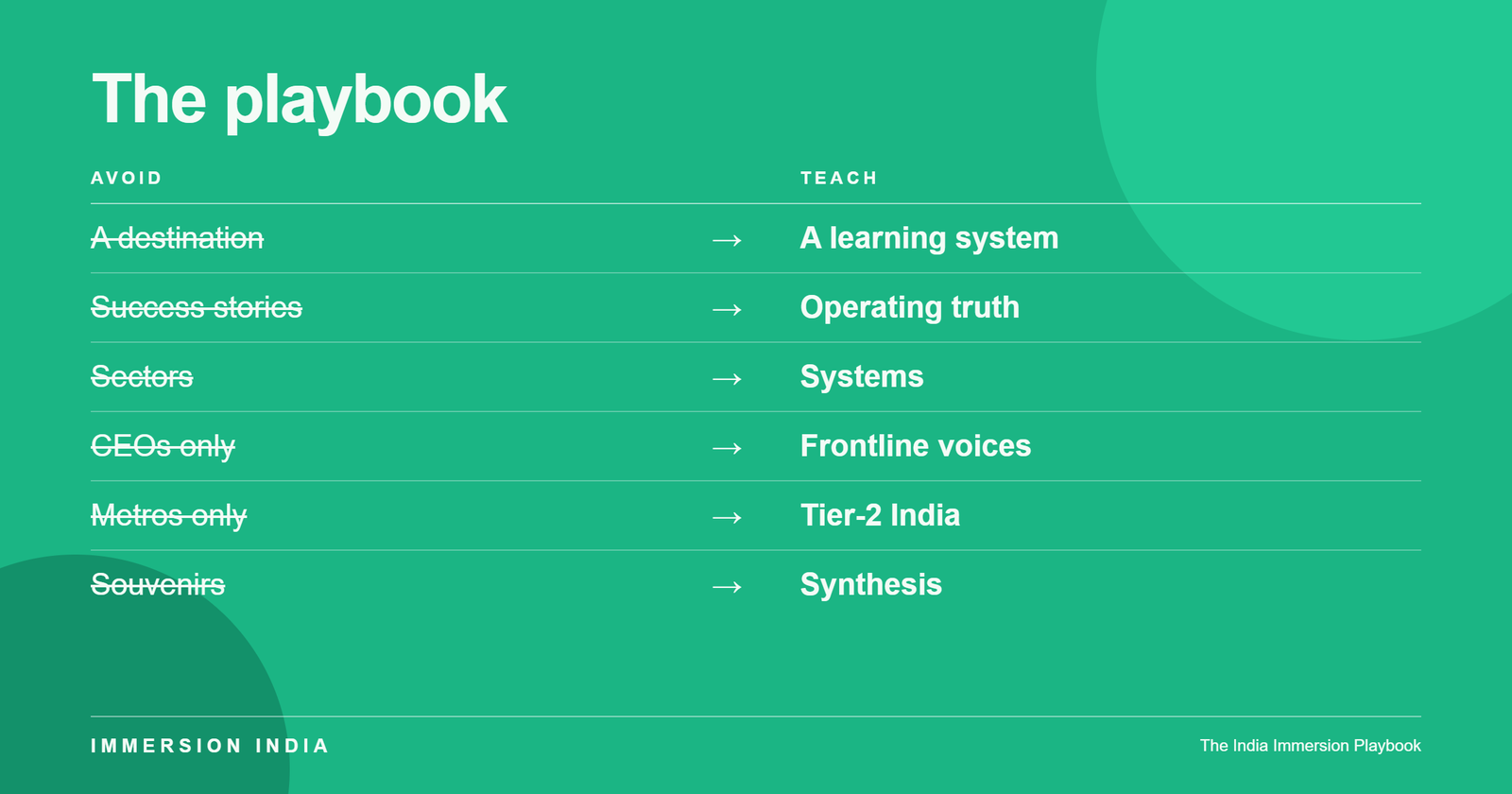
For global universities, this is the playbook. Do not bring executives to India only to admire its scale. Bring them to understand how scale is built. Do not show them only the companies that have succeeded. Show them the systems that made success difficult and therefore meaningful. Do not limit the journey to the familiar cities. Take them to the markets where the next India is already being formed.
India is not a case study waiting to be explained. It is a classroom in motion.
And the best immersion programmes will be those that learn how to teach from that motion.


