
Sustainability and inclusion have become standard features of corporate discourse. Targets are set, frameworks adopted, disclosures expanded. Yet, in many markets, these remain largely strategic overlays, important, but often detached from the mechanics of day-to-day execution.
India presents a different picture.
Here, sustainability and inclusion are less often articulated as standalone agendas and more often embedded as operational necessities. Constraints, of energy, infrastructure, income distribution, and access often force organisations to translate intent into workable models.
For executive cohorts, this shifts the conversation from “what should be done” to “what actually works under pressure.”
Energy transition as an operating constraint
India’s energy landscape is frequently framed in terms of transition, renewables growth, grid modernisation, and policy ambition. On the ground, the more immediate reality is managing energy reliability and cost simultaneously.
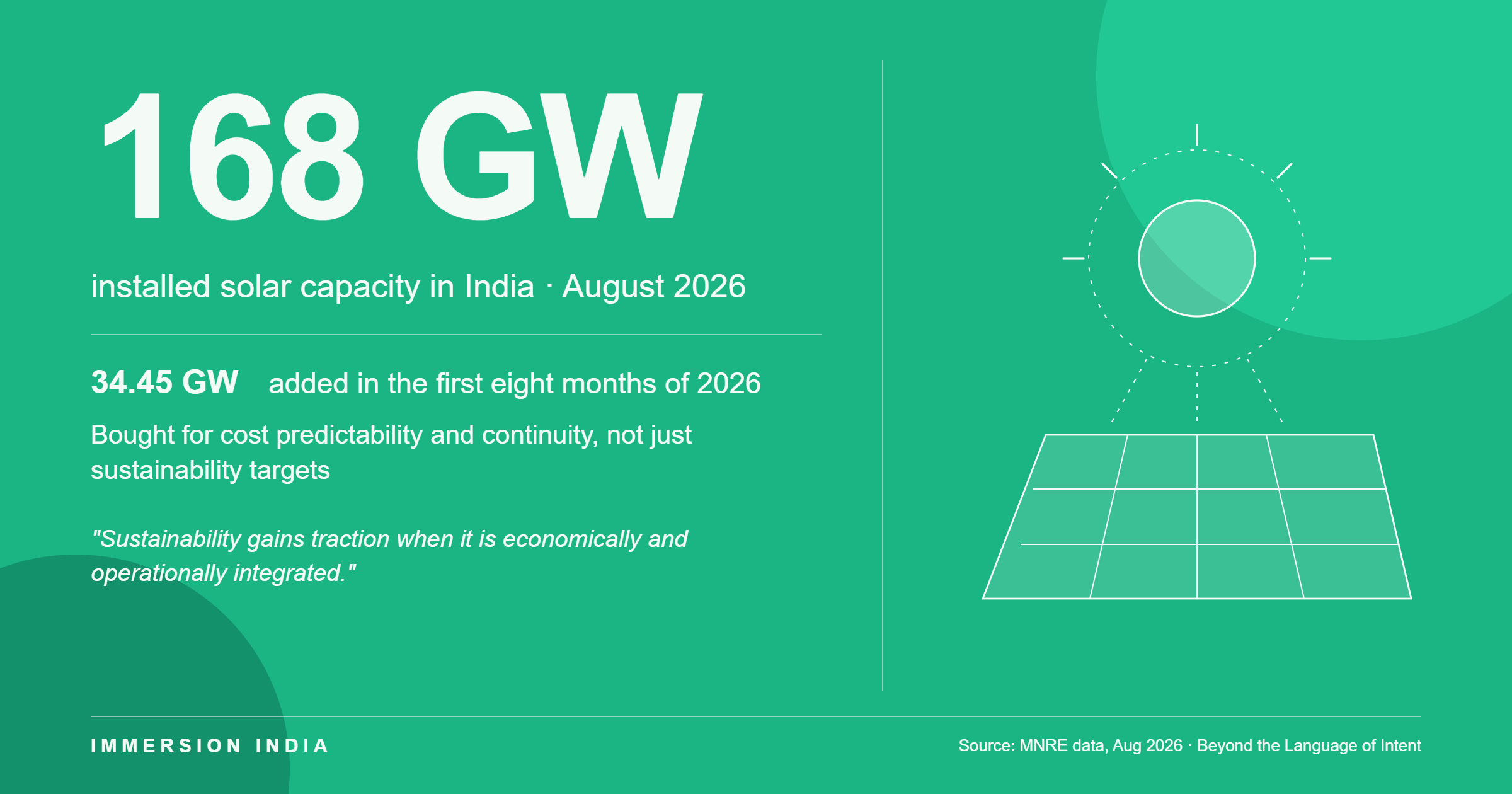
Manufacturers, for instance, often operate with hybrid energy strategies such as grid supply supplemented by captive generation or renewable sources. Commercial enterprises increasingly invest in solar not only for sustainability targets but for cost predictability and operational continuity.
This creates a pragmatic approach to sustainability:
- Investments are evaluated not only on environmental impact but on payback periods and resilience gains
- Adoption is phased, often starting with high-consumption nodes
- Solutions are adapted to local infrastructure realities rather than ideal-state models
For visiting executives, the lesson is clear: sustainability initiatives gain traction when they are economically and operationally integrated, not treated as external commitments.
Inclusion as market design
Inclusion in India is not confined to corporate social responsibility. It is deeply tied to market expansion.
Large segments of the population remain highly price-sensitive, digitally variable, and geographically dispersed. Reaching them requires rethinking product design, pricing, and distribution.
This has led to innovations that are both commercially viable and inclusion-oriented:
- Low-ticket financial products designed for first-time users
- Simplified onboarding processes, often leveraging digital identity infrastructure
- Assisted service models that bridge digital literacy gaps
In many cases, inclusion is not a cost centre. It is a growth strategy.
Executives observing these models often recognise a broader implication: inclusion is most sustainable when it aligns with unit economics, not when it depends on subsidy.
ESG pragmatics: trade-offs made explicit
Environmental, Social, and Governance (ESG) frameworks tend to assume a degree of stability, usually predictable regulation, mature infrastructure, and relatively uniform stakeholder expectations.
India’s environment makes trade-offs more visible.
A company may need to balance:
- Environmental goals with energy availability
- Labour formalisation with employment generation
- Supply chain transparency with vendor viability
These are not theoretical dilemmas. They are operational decisions made daily.
What distinguishes effective organisations is not the absence of trade-offs, but the clarity with which they are managed and communicated. Leaders are often explicit about sequencing like what can be done immediately, what requires ecosystem evolution, and where compromises are temporarily necessary.
For executive learners, this introduces a more nuanced understanding of ESG: not as a checklist, but as a dynamic balancing act shaped by context.
The role of digital public infrastructure
One of the more distinctive enablers in India’s sustainability and inclusion story is its digital public infrastructure.
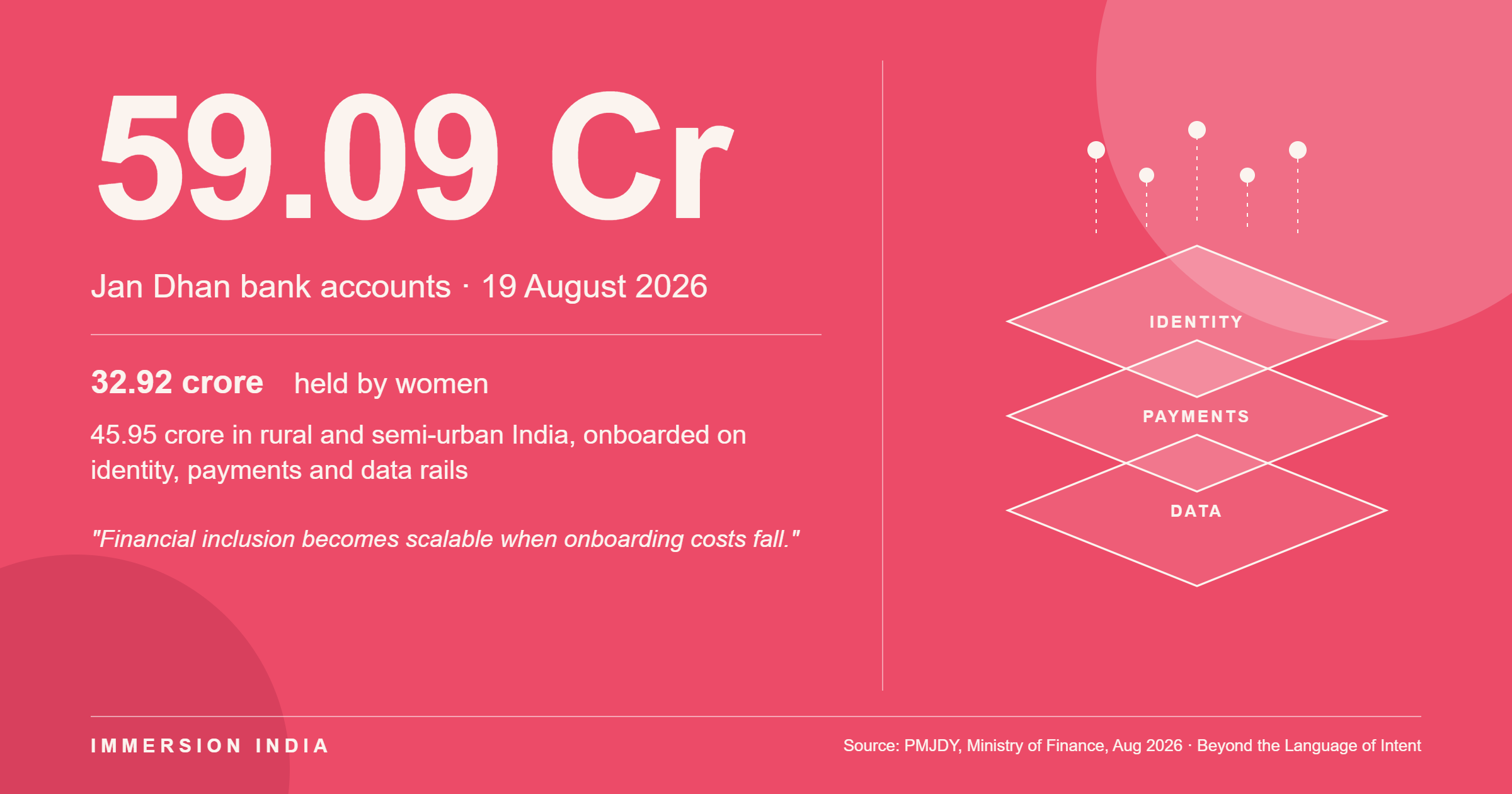
Systems for identity, payments, and data exchange have reduced friction in accessing services. This has implications across sectors:
- Financial inclusion becomes scalable when onboarding costs fall
- Government benefits can be delivered with greater precision
- Small enterprises gain access to formal financial systems
For businesses, this creates an environment where inclusive models can scale without prohibitive cost structures.
Executives encountering these systems during immersion programmes often see, in practical terms, how infrastructure design can influence social and economic outcomes. It is not simply technology adoption; it is system-level enablement.
Urbanisation and the sustainability paradox
India’s urban growth adds another layer of complexity. Cities are engines of economic activity, but also focal points of environmental stress, namely air quality, water management, and waste systems.
Companies operating in urban environments are increasingly required to engage with these challenges directly:
- Real estate developers incorporate water recycling and energy efficiency as baseline features
- Logistics firms optimise routes and fleet composition to manage emissions and cost
- Service providers adapt operations to local infrastructure constraints
What emerges is a pattern: sustainability is addressed not in isolation, but through incremental improvements embedded in core operations.
This may appear less dramatic than large commitments, but it is often more durable.
Inclusion within organisations: beyond policy
Internally, Indian organisations face their own inclusion challenges such as workforce diversity, skill disparities, and geographic dispersion.
What is notable is the extent to which inclusion is approached through capability building rather than policy alone:
- Training programmes designed for varied educational backgrounds
- Career pathways that accommodate non-linear progression
- Distributed teams supported by digital collaboration tools
The objective is not merely representation, but productive participation at scale.
For visiting executives, this offers a contrast to more policy-driven approaches. Inclusion, in this context, is measured less by declarations and more by operational outcomes, who is able to contribute, and how effectively.
What this means for executive education
For universities designing immersion programmes, sustainability and inclusion in India offer a rich field of study precisely because they are inseparable from execution.
Cohorts can examine:
- How energy strategies are shaped by operational constraints
- How inclusive products are designed for viability and scale
- How ESG trade-offs are navigated in real time
- How infrastructure enables or limits sustainable outcomes
The emphasis shifts from frameworks to field observation and analysis.
From aspiration to application
The most consistent insight emerging from India is that sustainability and inclusion gain meaning only when they are translated into operating models.
This translation is rarely perfect. It involves compromise, iteration, and adaptation. But it is precisely this process that turns abstract commitments into tangible outcomes.
For global executives, the relevance extends beyond India. As markets become more resource-constrained, more unequal, and more complex, the ability to operationalise sustainability and inclusion will become a core strategic capability.
India does not offer a template to be copied. It offers something more valuable: a working demonstration of how organisations can move from aspiration to application under real-world constraints.
That, ultimately, is what makes it an indispensable classroom.


