
There is a tendency, particularly among visiting executives, to interpret India’s complexity as noise, something to be abstracted away in pursuit of cleaner models. That instinct does not survive first contact with the field.
India does not simplify itself for leadership frameworks. It compresses variables such as market heterogeneity, regulatory variation, infrastructure asymmetry, and stakeholder density, into a single operating environment. What emerges is not chaos, but a different test of leadership: one that rewards judgement under pressure, not just clarity of strategy.
For executive cohorts, this is where India becomes less a “market study” and more a leadership laboratory.
Ambiguity is not a condition, rather, a baseline
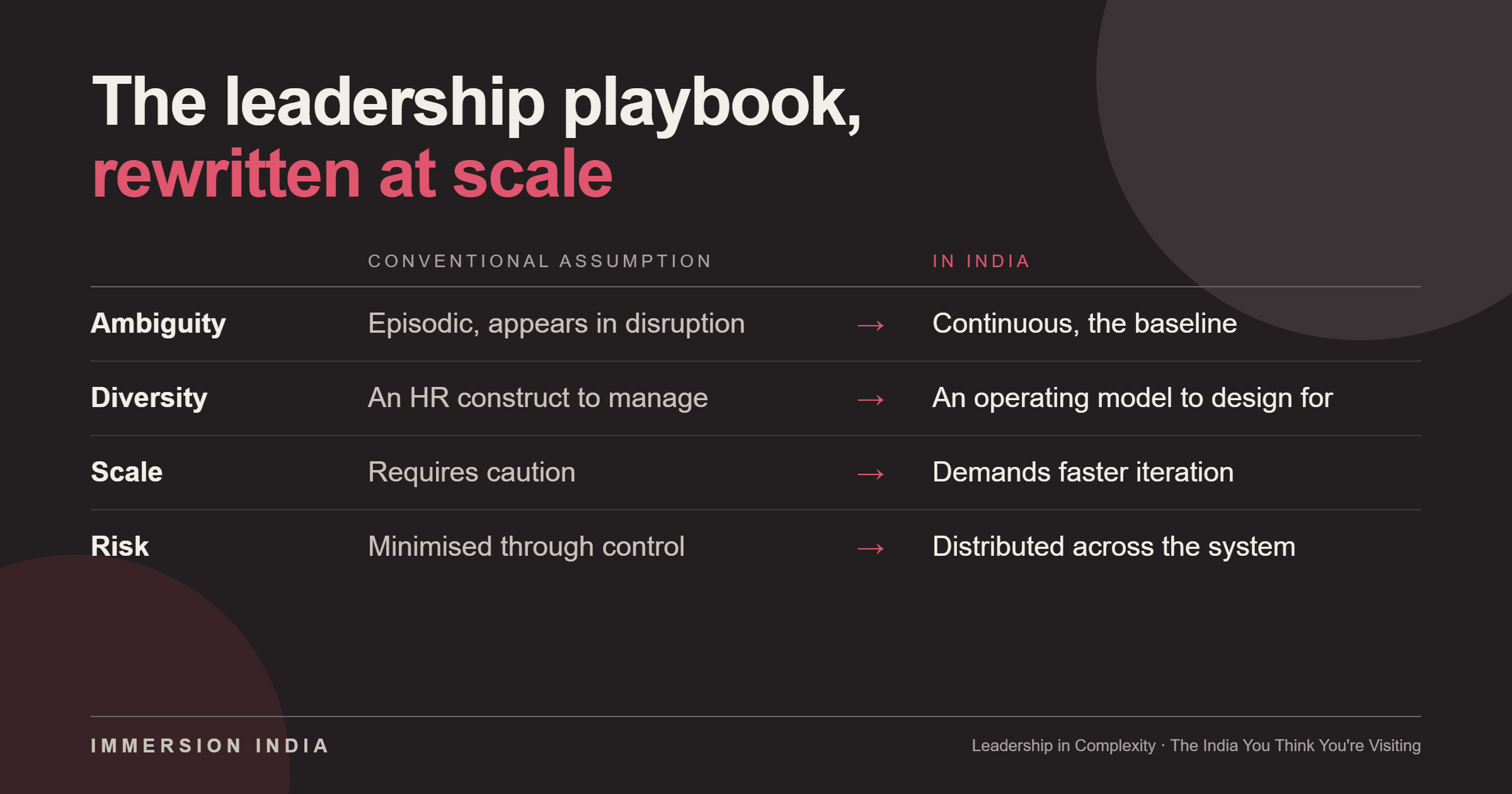
In many developed markets, ambiguity is episodic. It appears during disruption, regulatory shifts, or competitive inflection points. In India, ambiguity is continuous. Consumer segments evolve in parallel rather than sequence. Infrastructure quality varies within short distances. Policy intent may be clear, but execution pathways differ by state, sector, and institution.
Leaders operating in this environment do not wait for perfect information. They develop what might be called structured intuition, decision-making anchored in partial data, field signals, and rapid feedback loops.
During corporate immersions, visiting executives often observe frontline managers making decisions with incomplete datasets but high situational awareness. Pricing adjustments, distribution pivots, and service adaptations happen in near real-time. The lesson is not speed for its own sake, but confidence in calibrated risk-taking.
This is difficult to simulate in a classroom. It becomes visible only when decisions are traced from boardroom intent to field execution.
Diversity is operational, not demographic
India’s diversity is frequently described in cultural terms. For leadership, its implications are operational.
A single national strategy often fragments into multiple execution models, by region, income band, language, and access. Products are configured differently, channels behave differently, and customer expectations diverge sharply.
Leaders here do not “manage diversity” as an HR construct. They architect systems that can absorb variation without losing coherence.
This has two immediate consequences:
- Decentralised decision rights: Authority is pushed closer to the customer interface, with guardrails rather than rigid controls.
- Modular operating models: Core platforms remain consistent, but configuration layers allow adaptation at the edge.
For visiting cohorts, this reframes a familiar leadership question. The issue is no longer how to standardise for efficiency, but how to design for controlled variation without losing economic discipline.
Stakeholder density changes the leadership equation
In most markets, stakeholder management is a defined process, regulators, customers, partners, investors. In India, stakeholder density is higher, and their interactions are more interdependent.
A decision on pricing, for example, may have implications across distribution partners, regulatory interpretation, customer trust, and competitive response, often simultaneously.
This creates a leadership environment where sequencing matters as much as strategy. What is done, in what order, and with which stakeholders aligned, can determine outcomes as much as the decision itself.
Executives visiting India frequently note how much time senior leaders spend outside formal decision forums engaging with ecosystem participants, aligning expectations, and pre-empting friction points. This is not inefficiency; it is risk management embedded in execution.
Pace is a discipline, not a by-product
India’s speed is often remarked upon, but less often understood. It is not simply a function of market growth or digital adoption. It is the result of compressed feedback cycles.
Digital public infrastructure, mobile penetration, and platform ecosystems mean that customer response, transaction data, and operational signals are available almost instantly. This shortens the distance between action and consequence.
Leaders who succeed in this environment do not just move quickly; they institutionalise learning at speed. Pilots are smaller, iterations are faster, and failure is contained rather than avoided.
For executive learners, this challenges a deeply held assumption: that scale requires caution. In India, scale often demands the opposite, faster iteration with tighter feedback controls.
Risk is distributed, not eliminated
Traditional leadership models often frame risk as something to be minimised through planning and control. In India, risk is more often distributed across the system.
Supply chains are diversified across geographies and vendor types. Customer acquisition spans multiple channels. Product portfolios are designed to balance high-margin segments with high-volume ones.
This distribution does not remove risk; it makes it manageable.
Executives observing Indian firms in the field frequently see portfolios that appear, at first glance, overly complex. On closer inspection, they are deliberately constructed hedges against volatility which is economic, regulatory, and operational.
The leadership lesson is subtle but important: resilience is not built through simplification alone, but through intelligent diversification within a coherent strategy.
Frontline execution is where leadership is tested
Perhaps the most striking aspect of leadership in India is how visibly it manifests at the frontline.
Strategies are not insulated from execution realities. Distribution gaps, service inconsistencies, and customer behaviour surface quickly and visibly. Leaders cannot remain abstracted from these signals.
During immersion programmes, site visits to manufacturing facilities, service centres, or distribution hubs, consistently reveal the same pattern: frontline teams exercising judgement within broad strategic intent.
This requires leaders to do two things well:
- Communicate intent with precision so decisions made at the edge align with organisational goals.
- Build trust in execution layers so decentralised decisions do not fragment the enterprise.
This is leadership as system design, not just direction setting.
What this means for executive education
For universities and programme designers, the implication is clear. Leadership cannot be taught effectively through case studies alone when the operating environment itself is the teacher.
India offers a setting where executives can:
- Observe decision-making under persistent ambiguity
- Understand how diversity reshapes operating models
- Experience stakeholder complexity in real time
- Analyse how speed and scale interact in execution
The value is not in extracting universal answers, but in sharpening contextual judgement—the ability to adapt leadership approaches to environments where variables cannot be neatly controlled.
From clarity to capability
The enduring lesson from India is not that complexity can be eliminated. It is that it can be navigated with discipline.
Leaders who succeed here are not those with the most elegant strategies, but those who can translate intent into action across fragmented, fast-moving, and high-stakes environments.
For visiting executives, this often marks a shift. Leadership is no longer seen primarily as a function of vision and alignment. It becomes a function of decision-making under constraint, at pace, and at scale.
That is not a peripheral skill. It is increasingly the core capability required in a world that is, in many ways, becoming more like India.


